Showing posts with label del rio. Show all posts

Wednesday, February 23, 2011

The Beginning of the End of Our West Texas Adventure - Del Rio to San Antonio

With Waylon and Willie and the Boys
After several weeks exploring West Texas from our temporary home in Del Rio, we packed up the dog and decided to start making our way back home.  We knew that this would be a long journey back to Missouri, as we still had a lot to see, including one of our premiere destinations, San Antonio.  So Tuesday morning we headed north out of Del Rio on highway 277 up to Sonora, and made a roundabout trip over towards Fredericksburg.  This was a day full of views and history, including Roosevelt, Junction, the ever beautiful and fantastic Fredericksburg, and the little old town of Luckenbach. Read about these places and more by following us through photos in our Facebook Album here.

We'll blog a lot more about San Antonio next, as we continue our journey home to Warsaw, Mo.

Tuesday, February 22, 2011

Pecos to Del Rio via Fort Stockton

When you come into Pecos on I-20 from Toyah, you might think this is a pretty big town.  However, once you get past the string of Hotels along the Interstate, you realize that the main part of town is much removed from the hustle and bustle of the Interstate, and the reason for the hotels is simple.  There's not a lot going on in this part of West Texas, and for many, this is the only option for an overnight stay. That might also explain why the speed limit in this part of Texas is 80mph.  People tend to want to move as fast as they can back to civilization.

West of the Pecos Museum Saloon
We had a pretty long day when we pulled in, so it was nice to find the comfortable room at the Quality Inn after being turned away by other hotels.  A little exploring the next morning, after a nice tasty breakfast at Abi's Kitchen, found us at West of the Pecos Museum.  Located in an 1896 Saloon and 1904 Orient Hotel, this gem of West Texas is an internationally recognized historic landmark and a must stop for history lovers.  The Saloon has been restored and tells the story of the infamous gunfight between Barney Riggs and the henchmen of the notorious Jim Miller.  Three stories of rooms filled with area history are well worth the small admission price. While your there, make sure to go outside to see the grave of famed gunfighter Clay Allison.  And before heading out of Pecos, be sure to see the Pecos Rodeo grounds, home of the Worlds First Rodeo.  I'm sure some of you are saying that couldn't be, but Pecos is home to the first rodeo that offered prize money.

Paisano Pete, the Worlds Largest Roadrunner
We didn't get back on I-20, opting instead to head south on Highway 285 back to I-10 and Fort Stockton.  Lot's of history here with an Historic Downtown, the Annie Riggs Memorial Museum, and of course Fort Stockton Military Post, established in 1859.  This is a nice place to visit and shop the quaint shops in downtown, along with soaking up the history of this favorite rest stop along the Comanche Trail to Chihuahua, San Antonio-El Paso Road, The Butterfield Overland Mail Route, and the San Antonio-Chihuahua freight-wagon road.

A Scenic Overlook above Ft Lancaster
From Fort Stockton, we head East down I-10 and cut off onto Highway 349 for a side trip to Fort Lancaster.  The old post is located about ten miles east of Sheffield in Crockett County. It was one in a series of forts erected along the western Texas frontier,  established in August,  1855, to guard the military supplies, commercial shipments, and immigrants moving along the San Antonio-El Paso Road. Today, there is little left of the old post but ruins. Fort Lancaster was abandoned by the U.S. Army during the Civil War, at which time it was taken over by Confederate troops from December, 1861 through April, 1862.  It was then abandoned and the buildings began to deteriorate from vandalism and the harsh climate.  The drive is scenic however and it's worth a stop for history buffs.
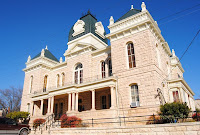
Crockett County Courthouse
Back onto I-10 we head to Ozona, called the "Biggest Little Town in the World."  Ozona is the only city in Crockett County, which encompasses over 3,000 square miles, and sports a population of around 3400.  Crockett County was founded in 1875 and named in honor of Davy Crockett, the legendary frontiersman who died at the Battle of the Alamo.


Devils River
From Ozona, we get off the Interstate and start our trek back to Del Rio via scenic 163 to Comstock.  Along the way you will cross the Devil's River.  Near here once stood Camp Hudson, established by the U.S. Army in June, 1857 to protect the San Antonio-El Paso Road against hostile Indians. The post was evacuated during the Civil War, but, re-occupied afterwards. It was abandoned again in April, 1868. Unfortunately, there are no remains today. This area, also called Baker's Crossing is a popular entry point for rafters along the river.

Getting back to Del Rio we feel we have seen what we came for in this part of West Texas, and start making plans to wrap up our extended stay and head home.  Of course, it won't be a direct route, as there is much more to do, including Sonora, Fredericksburg, and a little town made famous through music on the way to San Antone, one of our premiere destinations of our long journey in the Lone Star State.

In the meantime, follow this part of our trip in pictures via our Facebook album here.

Thursday, February 17, 2011

On the Way to Big Bend

We headed out from our temporary home base in Del Rio Tx on Monday morning for a 3 day excursion through West Texas, including Big Bend, Ft. Stockton, Pecos and more.  Our first day got us to Big Bend.  Rather than blog about that part of the trip here, I thought it would be more appropriate to let you see in pictures (with captions of course) what we found on the way.  You don't have to be a Facebook Member to see these photos.

Just follow the link
http://www.facebook.com/album.php?aid=281129&id=110001784731

We'll blog about our other two days soon, and share more photo's via our Facebook Fan Page.

Sunday, February 13, 2011

Onwards to Langtry - Home of Judge Roy Bean

Needing much more Old West mentality than the civilized city of Del Rio can provide, we head to the northwest across what can best be described as a sagebrush desert. Some 30 miles northwest of Del Rio we come to Comstock, a ghost town, having some 300 residents, it doesn't appear to be faring extremely well. And, unfortunately, even it's buildings are not interesting enough to spend much time pushing my magic shutter button. Though it got its start as yet another railroad town in the early 1880's, it never grew very much and today, there is little left of that history. It does have an old cemetery, which is filled with far more people than live in the town today. It still features an active hotel, and, perhaps a couple of other businesses.

Moving to the northwest, we pass by the old townsite of Shumla, established in 1882 as a section station on the Galveston, Harrisburg and San Antonio Railway. Today all that is left is an old row of buildings which once served as a motel, service station, and store.
Then we're off to the Pecos River Crossing. High canyon walls dominate the last sixty miles of the Pecos River before it enters the Rio Grande River. The Southern Pacific Railoroad built the first high bridge across the Pecos River in 1891. In June 1923, the Texas Highway Department constructed an automobile bridge to replace an old canyon-bottom crossing, but, it was washed away in 1954. Two temporary low water bridges in 1954 and 1955, were also destroyed by floodwaters. This bridge was completed in 1957. It is 1310 feet long and is the highest bridge in Texas at 273 feet above the water level.

North of the highway bridge is an observation point where visitors can see the Southern Pacific Railroad in the distance. This was also the site of the town of Vinegarroon, where Roy Bean first set up a saloon in the area. When the bridge was complete, Bean moved on to Langtry. Situated on private property, neither the bridge nor the old townsite are accessible today.

Headed north once again we cross Eagle Nest Canyon. Down below on the southwest side of the bridge is a place called Bonfire Shelter. Tracing its history back more than 11,000 years, Bonfire Shelter is known as being both the earliest and the most southern bison jump site in North America. Bonfire Long before Native American obtained horses, they stampeded herds of bison off the edge of this cliff, which overhung a shelter of a box canyon that empties into the Rio Grande River near Langtry, Texas. The bridge is located just southeast of Langtry.

We then arrive at our primary destination -- Langtry, Texas, the long-time home of crazy Judge Roy Bean. The town got its start as a camp called Eagle Nest when the Southern Pacific Railroad was being built through the area. Judge Roy Bean soon arrived, after the nearby town of Vinegarron was abandoned and "set up shop" once again. He ran his court and his odd type of justice out of his saloon, which he called the Jersey Lilly, named in honor of Lillie Langtry, the actress of his dreams. Bean died in 1903 and is buried in Del Rio, Texas.

The town began to decline after the highway was moved to the north of the city and when the Southern Pacific Railroad moved its facilities away, the town nearly died, dropping to a population of just about 40 people. The town stays alive today due to tourism to the Judge Roy Bean Visitor Center and still supports a couple of businesses.

We have a great time exploring the many old buildings of Langtry, many of which are mostly on the ground. Then we're off to find its sad little cemetery. No longer used and falling into serious disrepair over the years, it still provides volumes in my imagination and shutter opportunities. We then make our way right to the edge of the United States, looking over the Rio Grande River to Mexico.
 
Then, its back the way we came, "home" to Del Rio.

Tuesday, February 08, 2011

Exploring Del Rio, Texas

Over the weekend, we decide it is high time that we explore, in depth, our new temporary "hometown." We start by visiting a local arts and crafts bazarre, where I find great deals on turquoise jewelry, meet Chamber of Commerce members as well as a Val Verde County judge, and buy the wierdest hat you've ever seen. It's a cowboy hat made of Coors Lite boxes. Yes, a little crazy, but I can't resist and prancing around the bazarre in my new hat, soon find myself the object of a newspaper photographer. Three days later, we make the front page of the Del Rio Herald, under a headline prounouncing "Bazarre Winter." Wasn't exactly how I wanted to present Legends of America to our new diggs, but, had a lot of fun with it. After the bazarre, we begin to make our way around the city.

Prior to any European occupation of the area, the land surrounding Del Rio had been called home by Native Americans for over 10,000 years. The first non-Indian residents were the Spanish who established a small mission complex in 1736 near the site of present Ciudad Acuña, Del Rio’s Mexican sister city. Just a few of these Spaniards would settle north of the Rio Grande River, but, no permanent settlement would be established until after the Civil War.

The town would really get its start after the San Felipe Agricultural, Manufacturing, and Irrigation Company was established in 1868. Building a network of irrigation canals from the water provided from San Felipe Springs, these investors sold small tracts of rich farmland to prospective buyers. Soon, the settlement that began to grow took on the name of San Felipe Del Rio. The name was later shortened to Del Rio when the community gained a post office in 1883.


One of the oldest buildings in the community is the 1870 Perry Mercantile Building, which was one of the largest mercantile establishments between San Antonio and El Paso, Texas. It now houses the Whitehead Memorial Museum. A great stop, the museum, situated on three acres, is actually a complex made up of several structures, including a chapel, a reconstructed Jersey Lilly Saloon, and several other buildings, which feature the area’s Spanish, Mexican, American, and Indian history.

We then roam around town snapping pictures of a number of beautiful churches, the 1887 limestone courthouse, and travel along San Felipe Creek, which runs through Del Rio downstream to its confluence with the Rio Grande River. The clear waters of the creek have long been favorite swimming holes for residents. Fed by San Felipe Springs, the third larget spring in Texas, it feeds over 90 million gallons of pure water into San Felipe Creek each day. The springs have a long recorded history as an oasis for Native Americans, explorers, soldiers, and freighters. 

Continuing to spy a large artificial looking mound in south Del Rio, we find our way to what is called the Hill of the Cross, Round Mountain, Sugar Loaf Mound, and other names. The cross was placed atop the steep hill by the owner of the land, Dona Paula Losoya Taylor to recognize several people who were killed at the hill, fighting Mexican rebels and bandits. This cone-shaped hill has a number of legends including ghosts and hidden treasure. We'll be sure to share those soon.

Near the Hill of the Cross is the old Cementerio Loma de la Cruz. The same lady who placed the cross atop the Hill of the Cross, donated the land for a cemetery in 1872. Buried there are three former U.S. Army Indian Scouts and the Reverend Ramon V. Palomares, first pastor of Del Rio's Mexican American Methodist Church. The last burial here took place in 1933. As we make our way through the historic, we are, at first appalled, at what appears to be serious vandalism. Headstones are toppled and broken, monuments are tilted, ground level vaults are split and some, partially open. However, as we continue to roam through the lives of these distant people, it begins to appear that this area has been badly damaged by floods. We later discover that the old cemetery is located in a flood plane and was diluged by one of Del Rio's worst in 1932, which would explain why the cemetery discontinued use the next year. Later floods have also taken their toll on this sacred ground.

Taking a drive out to the Amistad National Recreation Area at the northern edge of Del Rio, we spy some of bluest water we've ever seen in a lake. This is the United States portion of International Amistad Reservoir, formed on the Rio Grande along the border of the U.S. and Mexico. The dam that created this reservoir on the junction of the Devil’s, Pecos and Rio Grand Rivers was a joint U.S.-Mexico project and takes its name from the Spanish word for friendship. Lake Amistad is known for great fishing, excellent water-based recreation, and a haven for snowbirds and their R.V.'s.

Stay tuned as we continue to explore the area, including Judge Roy Bean and Langtry, Texas; the Devil's River, more of the Pecos Heritage Trail, Fort Davis, and lots more.

Monday, February 07, 2011

Bracketville, Fort Clark & the Pecos Heritage Trail

We arrived in Del Rio on the evening of February 1st. After being on the road for several days, we needed a few days to rest and time to catch up, set up new office space, etc. Luckily we were just a day ahead of the storm most all the way - blizzards in Oklahoma, ice in Dallas, and the day after we reached Del Rio, temperatures in the 20's for several days. We didn't mind though, because, we were watching the weather at home - 18 inches of snow and temperatures in the single digits.


After catching up and staying warm for the first few days, we venture out on our first day trip to Brackettville, Texas, where we snap lots of pictures and spend time at Fort Clark. Unlike many other frontier forts that were prominent in the Indian Wars, Fort Clark, situated in south-central Texas remained an active post through World War II. It was founded in 1852 and inactivated in the mid-1940's. The southern anchor of the Texas  defense line in the 1850's, it guarded the San Antonio-El Paso Road and policed the Mexican border. We also make a visit to the  Seminole Indian Scout Cemetery about three miles south of town, which includes the graves of four Congressional Medal of Honor Recipients with service at Fort Clark. 


Brackettville, the county seat of Kinney County, got its start at the same time as Fort Clark -- in 1852. It was named after Oscar Brackett who was a sutler to Fort Clark. The community experienced a period of steady growth after the Civil War, attracting cattle rustlers, buffalo hunters, gamblers, and businessmen. There are some very interesting old buildings in the town. Seemingly, this small town doesn't tear down its old buildings, which is a photographer's heyday. Stay tuned, we'll be bringing you more on Brackettville soon.

Then we're off to do just a short stretch of the old  Pecos Heritage Trail between Brackettville and  Rocksprings. This trail, covering more than 1,300 miles provides visitors with a diverse landscape, including sand dunes, underground caverns, spring-fed pools, numerous rivers and creeks, lakes and much more. Encompassing 22 counties, seven state parks, dozens of towns, and hundreds of historical, cultural, natural, and recreational destinations, we're not going to do this in one stretch, but, rather, hit pieces of it at a time as we roam the area.


We do a quick tour of  Kickapoo Cavern State Park; but, not being much into caves, we quickly move on to Rocksprings. The county seat of Edwards County, Rocksprings received its name from natural springs that bubble forth from the porous limestone rocks in the area. Founded in 1891, the area had previously been long favored by pioneers and native peoples. The only incorporated town in Edwards County, it has a population of about 1,300. 


 We then make our way back to Del Rio to make plans for more upcoming adventures.

Wednesday, February 02, 2011

Austin to Del Rio

Our last day on the road before reaching Del Rio, starts with a bang with a personal tour of the Bob Bullock Texas State History Museum. Thanks to Linda Pybus Glover, who works with the museum and just happens to be a Legends reader, we were able to get a personal tour with wonderful history. 


The museum tells the “Story of Texas” with three floors of interactive exhibits and special effects shows, and is worthy of the Lone Star State. Unfortunately, due to the nature of the exhibits being on loan from other Texas museums, societies and individuals, we were unable to take photos to share with you. Definitely worth the visit to see for yourself! 


Then, with Del Rio still some 230 miles down the road, we plan few stops. We will return to the San Antonio area and dedicate a couple of days. The rest is day-trippable, and you will be hearing lots more.

That being said, we can't resist a stop at tiny D'Hanis, Texas, about 50 miles west of San Antonio. First established in 1847, the building of nearby Fort Lincoln in 1849 afforded the settlers employment and much-needed protection from Indian raids. By 1850, it sported 20 homes and a school. In 1854, it became a stage stop on the San Antonio-Rio Grande Road. The beautiful St. Dominic's Church was built in 1869. 


Today, only ruins are left but still worth a stop for the photo opportunity. In 1881, when the Galveston, Harrisburg & San Antonio Railway built across Medina County, it bypassed old D'Hanis, and a new town grew up around the railroad loading depot 1½ miles west. Today, D'Hanis still supports a small population and has a few remaining businesses, but a visit is like stepping back in time.


We then barrel on through to Del Rio, in search of our new diggs. We have rented a two bedroom furnished apartment that provides us with good internet, dishes; all we need for living for 30 days, and allows our little dog, KayDee. We spend the rest of the evening setting up our new "headquarters." Next morning, it's unbelievably only 26 degrees, but we weren't planning a travel day anyway. We stock up on groceries, explore the town a little, and we're back to work. By weekend, temperatures are supposed to return to normal and we will begin our adventures.

Stay tuned as we explore southwest Texas, taking in such places as Big Bend National Park, Fort ClarkFort Stockton, Langtry, the Pecos Heritage Trail and much more.


Follow us in photos via Legends page on Facebook.