Monday, November 05, 2012

Jim Hinckley Contributes to Legends

Author Jim Hinckley
Legends Of America is proud to announce that award winning author Jim Hinckley is now an official contributor to our website.  Many are already familiar with Jim's fantastic works, including books on Route 66 and Ghost Towns. Jim is also known in the auto world as a former Associate Editor of Cars and Parts Magazine, where he contributed a monthly column profiling the independent thinkers of the American Auto industry.

His love of history, especially that of Route 66 and the American Southwest, shine bright through his photography and his writings.  Jim says "After years of having friends and associates tell me that I was blessed with a gift for telling folks where to go, and with support from my loving wife, I began writing about my passion for lost highways, the road less traveled, the special places found along the way, and the vintage vehicles that once traveled them."   Eight books have resulted from that passion to date, along with more than a thousand feature articles for a wide array of publications including Old Cars Weekly, Classic Auto Restorer, American Road and others.  Jim was also featured in an interview with Jay Leno on Jay Leno's Garage.

In 2010, Jim was one of several Co-Authors, including Legend's founder Kathy Wesier-Alexander, for the book "Greetings From Route 66".  It was during this project we became more familiar with Hinckley's work and began following his adventures.  After several attempts to connect, always interrupted by life on our end, we finally had the chance to sit down with Jim at last months Cuba Missouri Route 66 Festival. Our partnership formed quickly over some bacon, biscuits and gravy.  And who doesn't like bacon?  It was enough for us to know it would be a productive agreement.  Jim blogged "To say I am excited about being a contributor for this website would be a gross understatement as it has been a favorite of mine for years." 

We look forward to bringing you Jim's passion on a regular basis, including two new stories already published.  "Two Heads are Better Than One"  is the story of brothers F.O. and F.E. Stanley, legendary automobile pioneers who transformed the world with their genius.  And "Frontier Era Time Capsule", a look at the Johnson Canyon rail tunnel, an Arizona forgotten time capsule of large importance in American rail westward expansion.

Jim currently writes a blog "Route 66 Chronicles", about the life of a starving artist on Route 66, and says "It is my sincere hope that you find my books and articles an inspiration for over coming obstacles, discovering the joy that comes from seeking the road less traveled, and are inspired to make a road trip or two."

You can read more about Jim on his Legends Bio Page, which also has links to his various books and of course, articles on Legends Of America.

Please help us welcome Jim Hinckley to Legends Of America!
 

Wednesday, October 31, 2012

How to help Sandy Victims

Kathy and I send our prayers to everyone effected by Sandy.  The scenes have been heart wrenching, yet mixed with uplifting courage and strength.  As we have time and time again, American's will pull through due, in no small part, to the enormous generosity and caring of our citizenry.

If you can help, we suggest the following resources.

White House Release - How to help the Survivors of Sandy

Red Cross

Salvation Army

We look forward to seeing your full recovery as you write the next chapter in our American story.

Kathy Weiser-Alexander
Dave Alexander
Legends Of America

Tuesday, October 23, 2012

A Little Missouri 66 in October

Friday - Buying a New RV

Our New KZ Sportsman 200
If you're a reader of our Newsletter or this blog, you know that we borrowed a camper last month and took it to Tennessee to see if it was a feasible lifestyle for us.  After really enjoying the experience, we asked our Newsletter readers to chime in on their experiences and recommendations and received some great feedback.  Like making sure to think through the traffic flow inside the RV based on your typical occupancy. How's it work with 2 dogs?  Getting one with a larger fridge that runs on both propane and electric. Checking for any water damage, are the tires good, etc.  Lots of great advice that we took into consideration on our search.

With our towing capacity at 3500 pounds, we were limited in our choices for the size of camper we required. We both knew that one of us would wind up hurt in less than a 19 foot trailer (probably me).  Having separate offices at home, in separate buildings, has made us a bit spoiled in that aspect. In short, what we found out is that until about 2010, most travel trailers 20 feet were over 3500 pounds, but gas prices seemed to have forced the industry to develop more light weight, larger trailers for fuel economy. That meant that everything we found 'used' that we liked was over our limit, while everything used within our limit was too small.

That ultimately led us to the KZ Sportsmen.  After looking at several floor plans, what was perfect for our needs was the Sportsmen Classic 200.  We never intended to buy a new camper as we are big believers in buying any vehicle used.  However, the price on these made it very appealing, especially when many of the used we had looked at were only a couple thousand cheaper.  So after many searches and phone calls, we found our's waiting for us in Cape Girardeau at Youngblood's Capetown RV. That's six hours away from Warsaw, but we thought why not make it another adventure and spend some quality time coming home along Missouri Route 66.   (This is obviously our first experience at buying a camper, so won't give Youngblood's nor the Sportsmen a complete review other than to say the staff was friendly, they worked with us a little on price, went over everything in the camper, and even let our dogs come in for the paper work signing.  No complaints).

Saturday - Towing Our New Mobile Motel Home in Missouri Color
Missouri in October is very colorful (just outside of Cape Girardeau)

We stayed in Cape Girardeau at Cape Camping RV Park.  Very clean park, nice pull through's to make it easy on me that first night, and level.  But this is what Kathy refers to as RV Parking lots.  Row after row, close together and NO trees. Close together not really that big of a deal, but the lack of shade and the feeling of being in a parking lot would exclude this place as a long term stay for us.  Also, I thought it was odd to have a speed bump coming in the park, which led us to our first indication that we need to secure the cabinets in the camper better.

Meramac Barn east of  Stanton, Missouri
We wasted no time getting on the road Saturday morning, with our ultimate destination being Cuba Missouri, which just happened to be having their annual Cuba Fest.  So we head up I-55 to Festus, then cut across to St. Clair to catch the Mother Road. Beautiful colors this time of year with Fall in full swing, we felt it was the perfect time for Route 66, which meandors along the frontage road of I-44. St. Clair was established in 1849 as "Travelers Repose" but changed to its current name in 1855.  With small town charm and attractions, make time to stop here if you can. (Read more about this stretch of 66 HERE)

Continuing west we go through a favorite for 66'ers, Stanton.  Close to Meramac Caverns, there are some interesting attractions beyond the cave here, including the Jesse James Museum.  If your into 66 history like us, you also want to get a pic of the now closed Antique Toy Museum which attracted many over the years before being closed down in 2009.  (More about Stanton HERE)

Sullivan is also nearby, founded in the mid 1850's.  With a revitalized historic downtown and it's close proximity to Meramac State Park, it's another great place to relax along your Route 66 journey before continuing west to Bourbon, thought to be the only the only town in the U.S. named after Bourbon Whiskey, an apparent result of Irish immigrants who helped build the railroad.  (More on Sullivan and Bourbon HERE)

Heading west, we're getting into Missouri Vineyard country, with several Wine Vineyards along our path to Cuba.  I never really thought of Missouri as a place for Wine making, but there are a lot of quality ones in this part of the country.  Established in 1857, Cuba got it's name from the island country and was known for its apple orchards and barrel making. Though the apple production declined in the 1930's, barrel making continues to this day.  It was also in the 1930's that the town picked up and moved the original town site next to the railroad tracks to be closer to the new Route 66. With that move, several services and tourist stops sprang up, including the now historic Wagon Wheel Motel. Starting as the Wagon Wheel Cabins in 1935, this motel is now on the National Register of Historic Places and continues to serve travelers today. Purchased in 2009 by Connie Echols, the motel has been completely restored and feature some of the most unique original buildings left on the Route today.

Of course we had to stop in at the annual Route 66 Cuba Fest. Traditionally the third weekend in October, this event is a big draw for Mother Road fans, and featured trolley tours and plenty of 66 history and fun.  Make plans to attend in 2013 if you can.  You can find out more via the Cuba Mural City website and of course the Chamber of Commerce.  And be sure to read our story on Cuba (soon to be updated) HERE.

Still getting accustomed to hauling an RV, we decided it best to camp here for a night or two and see the sites without camper in tow.  We found a great RV park called the Lady Bug right outside of town.  Plenty of trees and a layout that doesn't make you feel your in a parking lot, this stop gets high marks from us.  Good internet, full hookups and a great price with friendly owners!  Couldn't recommend the Lady Bug RV Park and Campground enough.  The only problem, as of this writing, was the fact that Kathy's smartphone didn't get 3 or 4G service here, but the wireless internet provided was plenty adequate during the times of day we needed it most (early morning).

Sunday - Day Tripping down forgotten parts of the Mother Road
Worlds Largest Rocking
Chair

We started Sunday morning by having breakfast with our 66 friends Jim Hinckley and Rich Henry. Mr. Hinckley is a co-author with Kathy on "Greetings from Route 66", and has written several other books, including "Ghost Towns of Route 66", "Ghost Towns of the Southwest" and others. His latest endeavor just debuted and is sure to be a 66 Best Seller. "The Route 66 Encyclopedia" debuted at Cuba Fest and goes on sale November 1. Be watching Legend's General Store as we make it available soon. Hinckley came into Cuba all the way from Arizona, while Rich Henry came in from Staunton Illinois.  Henry runs the fun Route 66 must see attraction "Henry's Rabbit Ranch" and it was great to catch up with both of them along with Jim's wife Judy.

Feeling unencumbered with our RV back at the park, we left breakfast heading west on Old 66 to our first photo stop at the Fanning Route 66 Outpost, home to the Guiness Certified Worlds Largest Rocking Chair, which stands just over 42 feet tall and 20 feet wide.  From there it's down the road to Rosati, Little Italy in Central Missouri. This is most definitely wine country and Rosati has an intriguing history dating back to the 1840's.  Read more about this historic town HERE.
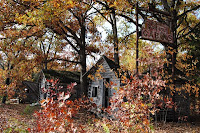
John's Modern Cabins
From Rosati we stayed on the Mother Road, going through St. James, and Rolla, each with plenty of history, but being the Ghost Town type geeks we are, our primary focus of the day was really an area just west of there off exit 176 and down Arlington Outer Road.  This section of Route 66 that was bypassed by I-44 in 1957, was bypassed even more when I-44 was again adjusted further north more recently. It's also the place you'll find the long abandoned John's Modern Cabin's, next to the still active and Route 66 Icon Vernelle's Motel. John's Modern Cabin's is on private property, but the owner allows you to walk around "at your own risk".  Nothing being done to preserve, these cabins that once served weary travelers are not long from being completely gone, so we were glad we made the trek to capture what's left in photos.

1860's Hotel still stands in Arlington
We had an extra treat just a bit further down this outer road when we reached the Ghost Town of Arlington. Founded in 1867, this was a popular resort town in the early days of Route 66, with a hotel that dates back to the original founding.  After Route 66 was widened then later bypassed the town it went into decline and today is privately owned.  We will be writing much more about Arlington soon as there is great history being restored here and new owners are making good use of the existing homes and historic hotel.

Stony Dell Resort
Still more to see in this area, we had to backtrack to the Interstate and venture off exit 172 to Jerome, just past the abandoned Stony Dell Resort.  Much like John's Modern Cabins, this once popular stop stands as a reminder of more leisurely travel days along Route 66.  Just before Stony Dell you will see the Trail of Tears Memorial, built by Larry Bagget.  The memorial was once a major attraction on the Route, but was abandoned after Baggets death in 2003 and is now closed off.

We wrapped up our day continuing on Old Route 66, through Devils Elbow and Hookers Cut before making our way back to the interstate and back to our camp ground outside of Cuba. It was a great day for history that you can see in our Facebook photo album "Fall In Missouri" HERE.

Ps. After spending quality time in our KZ Sportsmen 200, we both feel very much at home in it.  We believe this is going to fit our travel lifestyle well.

Why did the Turkey Cross the Road?  To see where Chicken went. 


Sunday, September 23, 2012

Buffalo Bill in Scotland?

Editors Note: The following guest post to Legends Blog is submitted by Fiona J. Johnston

Buffalo Bill In Scotland?


On the evening of 16th November 1891 in the city of Glasgow, Scotland, around 6,000 people gathered to watch the most exciting show of the age. Rumours had been circulating for weeks before the show's arrival and now the audience’s anticipation and excitement had reached a frenzied peak.

But finally the wait was over, and the first notes from the cowboy band carried across the cold sharp air as they started their rendition of the Stars and Stripes, and Buffalo Bill’s Wild West Show began.

A hundred years ago Buffalo Bill was a world class celebrity in the order of someone like Madonna or The Beatles today. Everyone would have known about Buffalo Bill and his Wild West Show, and everyone would be talking about his visit.

Ask today’s Glaswegians about Buffalo Bill and a few may know that in the Glaswegian suburb of Dennistoun there stands a commemorative bronze statue of Bill on horseback, fewer still are aware of the Scottish tour.

But one person will not let Buffalo Bill’s visit to Scotland fall into the shadows of history, Scottish writer and director Alan Knight. Alan is currently developing a documentary ‘Buffalo Bill In Scotland - An Evocation’ adapted from Scottish author Tom F. Cunningham’s book ‘Your Fathers The Ghosts – Buffalo Bill’s Wild West In Scotland.’

Knight was completely inspired by the book and has spent a lifetime in love with the Wild West and the great age of the American frontier. He set about further researching the Wild West tour thinking of ways he could adapt the book to the screen.

He soon discovered that there is little in the way of archive material surrounding the show’s visit to Scotland, although Buffalo Bill visited the country twice, once in 1891 and again in 1904 with his ‘Rough Riders Of The World.’ So Knight thought the best way around the problem would be to incorporate animations where archive material is missing.

Material on such characters as one George C. Davis otherwise known as Carter The Cowboy Cyclist who performed death defying acts of the most daring and sensational kind. Carter was the Evel Knievel of his day but instead of a motorcycle he used a push bike.

If that sounds a little tame to you, consider that this was at a time in history when bicycles were a luxury item only the very rich could afford. Most of the audience had probably never even ridden a bike, let alone thought about flying through the air on one.

Knight had a test animation of Carter created, quirky and fun but also totally reflective of the mood and time of the Wild West Shows, this was definitely the way forward. So he set his mind to developing a documentary adding multi-media into the usual documentary mix, creating an exciting modern take on this fascinating moment in history.

The Wild West Show played at only one Scottish city during the 1891 tour, Glasgow. During this great Victorian age the city was second only to London in the British Empire and was a huge powerhouse of industry and commerce.

When Bill visited Scotland the second time in 1904 with his Rough Riders Of The World Show he toured all over Scotland visiting towns such as Perth and Dundee and even went as far North as Inverness, the capital of the Highlands.

While in Inverness, two of the Indian company Iron Tail and Blue Shield took a trip even further North to John O’ Groats the most northerly settlement on the British mainland. They were accompanied by Mr. Small who had taken to dressing in a kilt while touring Scotland and was the show’s photographer.

Iron Tail in Glasgow, 1904
(photo courtesy of
Invisible Emperors Ltd)
An article in the Northern Ensign, a local newspaper, comments that both Indians were dressed in their ‘Native garb,’ and were ‘decorated with feathers.’ Local onlookers had a totally different view of the Indians. They were convinced the warriors were women!

After all, the Indians had long, dark hair and smooth skin on their faces, it was an easy mistake to make… However, the photograph sold well as a postcard, and the incident is a great example of Buffalo Bill’s showmanship and marketing skills.

No one knows if Iron Tail and Blue Shield found out what those John O’ Groats onlookers thought. And it is ironic that many of the Native Americans who travelled with the Wild West Show were warriors who had fought during the Wounded Knee massacre. Their lands lost to immigrants, and their culture suppressed by white Europeans, much like the ones they were now entertaining.

In fact, the Wild West Show was one of the few ways that the Native Americans were able to preserve their culture, through the display of traditional skills in horsemanship and archery.

The documentary will explore the response of the Scottish people to the show and will look at fantastic characters in the Buffalo Bill company, such as Charging Thunder, one of the Lakota contingent, who attacked George C. Crager, an interpreter with the show. Charging Thunder ended up in Barlinnie, a Glasgow prison, for 30 days after Colonel Cody called the police.

And Annie Oakley, who could famously split a playing card on its edge several times before it hit the ground, she was apparently so enamoured with tartan that she had some wonderful photographic portraits taken dressed in a tartan outfit.

If you'd like to see the photographs of Annie and find out about the progress of the documentary, then please click on the Facebook link below.

Please 'Like' the page to be kept up-to-date with other little known archive images as they're unearthed, as well as Buffalo Bill in Scotland historical information and video updates from the team of filmmakers.

Also keep October 2nd 2012 in your diary as that's the official launch of the Buffalo Bill in Scotland IndieGoGo campaign. The team are raising development funds for the documentary and will be asking for contributions so they can tell this wonderful story!

Fiona J. Johnston.

http://www.facebook.com/BuffaloBillInScotland
https://twitter.com/BuffaloBillScot

Thursday, September 20, 2012

Tennessee to Missouri (Day 10 - 12)

Day 10 - Perfect Timing for Chickamauga
Re-enacters firing the cannons during the 149th Anniversary of the Battle of Chickamauga 

Our final days in our Civil War tour east of the Mississippi found us at the "Gateway to the Deep South".  Chattanooga, TN and nearby Chickamauga, GA were the scene of several battles, including the second bloodiest battle of the war. In 1863, Union and Confederate forces fought to control Chattanooga, and on September 19 and 20, the Union suffered its most significant defeat in the Western Theater, with the second highest number of casualties in the war during the Battle of Chickamauga.

We just happen to be there the weekend before the 149th anniversary, and were fortunate enough to catch a little action while there.  Re-enacters shot off cannons as part of the commemoration of the battle that saw over 35,000 men either wounded, killed or missing in action.  We talked with a park ranger who indicated that they were not allowed to actually re-enact the battle in the park itself.  She did not give a specific reason, and we have yet to find one.  Plans are underway for a large remembrance event next year for the 150th anniversary, and we were told a re-enactment would be held nearby the park.

This was a must see on our tour.  The Chickamauga National Battlefield Park in Fort Oglethorpe Georgia has some 1,400 monuments and historical markers and a well put together driving tour.  We recommend this stop for all history buffs, and it's a great learning experience about some of America's darkest hours.

Boyhood Home of John Ross, Rossville, GA
Just down the road, back toward Tennessee in Rossville, GA, we found the two story log house that was once the boyhood home to Cherokee Chief John Ross.  Although only part Native American, Ross was elected "Principal Chief" of the Cherokee Nation for 40 years, and an advocate for justice for 57 years.  He voluntarily chose exile with the Cherokee people as they were forced onto the Trail of Tears, losing his wife along the way.

Chattanooga Choo Choo Historic Hotel
Back in Chattanooga TN, we made our way downtown for a quick peek at the Chattanooga Choo Choo. The first train pulled into this Gateway Terminal Station in 1909, with the depot growing to serve nearly 50 passenger trains a day.  With the decline of travel by rail, traffic at the depot slowed nearly to a halt by the 1960's, and after almost 61 years in operation, the grand old building was closed in August of 1970.  Local businessmen reopened it in April of 1973 as a unique vacation complex, and in 1974 it was listed on the National Register of Historic Places..  The Chattanooga Choo Choo Historic Hotel is considered one of the city's first historic preservation projects.

Craven House on Lookout Mountain
A few miles away, we found ourselves on Lookout Mountain.  During that bloody fall of 1863 as battles raged for Chattanooga, Lookout Mountain played key roles for both Union and Confederate forces. Both sides used the Craven House as an observation post and headquarters at some point, we a complete view of Chattanooga below.  The mountain had seen action before during the Summer and Fall of 1794.  It was then that American Settlers fought the Cherokee in a decisive success, now known as the "Last Battle of the Cherokee" during the Nickajack Expedition.
View from Lookout Mountain

On November 24, 1863, the Battle of Lookout Mountain during the Civil War saw a majority of hand to hand combat near Craven's house halfway to the summit.  On the day of the battle, fog descended about halfway down the mountain, leading to the event being called the "Battle Above the Clouds".  It would play a key role in the Union's ultimate victory for Chattanooga.

New York Peace Memorial,
Lookout Mountain
There's plenty to see and do here, with the Lookout Mountain Incline Railway, Ruby Falls Cavern, City of Rocks and Point Park.  We stopped at Point Park, which was completed by the Corps of Engineers in 1905 and dedicated to the Union and Confederate soldiers that fought there.  Inside the park you will find the New York Peace Memorial, standing 95 feet high and 50 feet wide at its base. On top of the shaft a Union and Confederate Soldier shake hands under one flag, signifying peace and the unification of America after the war.

It was a good day of touring without the camper in tow, so after a nice meal we headed back to our KOA campground to plan the next day.  Unfortunately, the forecast looked like it would plan it for us.

Day 11 - The Rain Out

Rainy day in Nashville :(
We got up Monday knowing that there were several inches of rain predicted for most of Tennessee.  After seeing that no matter which way we went we would be in rain, Kathy and I made the hard choice of moving north toward Nashville in hopes of getting out of the weather system.  It wouldn't be until we were past Nashville that it would finally slow down enough for us to do anything.

Abandoned business in downtown Adams, TN
We did find some bonuses (at least what we would call bonuses) along the way.  Adams Tennessee isn't a Ghost Town, but this small town of 600 appears to have lost their downtown businesses and the buildings provided some good picture opportunities. Just outside of Adams we wanted to see Bell Witch Cave, but unfortunately it was closed. The Legend of the Bell Witch dates back to the early 1800's. The story of farmer John Bell, settling in the area with is wife and children in 1804, starts around 1817 when members of the family began experiencing strange looking animals around the property, and late night sounds that were unexplained.  As time pased, Bell's account of what was happening at his home attracted many to come investigate.  Soon after, the noises became a voice which is said to have been a witch named Kate, bent on killing John Bell.  Bell died in 1820, some say by the hand of the witch.  Strange things have been reported here and in nearby Adams since. The cave has its own stories, and is said to be where the Bell Witch lives. Privately owned today, tours are given during the summer and October.

Guthrie, Ky
Down the road we stopped for more picture opportunities in historic Guthrie Kentucky.  Home to Pulitzer Prize winner Robert Penn Warren, author of "All the Kings Men", and the only person to have won Pulitzer Prizes for both fiction and poetry, Guthrie currently has around 1,500 residents. Established in 1867, the town saw major decline in the 1970's and reportedly had high poverty levels segregating it from its parent county. In recent years new plans for the future have been put in place  to revitalize the city, including a Guthrie Transportation Museum.

Cleaning up abandoned buildings
in downtown Cairo, IL
We kept pushing down the road, deciding we would go ahead and cut our RV adventure short and move closer to home.  Along the way we stopped in Cairo Illinois to revisit it's downtown.  Right at the convergence of the Ohio and Mississippi Rivers, this town once had a lot of promise, but racism and corruption would be its death.  Kathy was here a few years ago and since then we found that they are starting to demolish many of the abandoned buildings downtown as part of a revitalization effort.  We will be updating Kathy's very extensive story on Cairo soon.

That would be our final history related stop of the trip as we landed for one more night in the RV near Sikeston Missouri, still over 300 miles from home, and drove straight through Southern MO on Day 12 headed back to Warsaw. Despite the rain ending our adventure in Tennessee early, we did learn that the RV/Camper life is one we would enjoy immensely, and had a pretty good, easy stay at Town and Country RV Park near the intersections of I-55 and I-57.  Thankful that Kathy's sister Kristy and her husband Geno allowed us to use their camper, we are already planning to get our own, especially for our much needed Winter trips to the South.

Be sure to see the pics of our final days in our Facebook photo album Tennessee Back to Missouri HERE